A landlord in East Nashville called me on a Sunday evening, whispering, because his tenant was in the next room and didn’t know the house was for sale. That phone call happens more than you’d guess. Selling a tenant occupied property in Tennessee sits in a strange gap: you own the building, but somebody else holds the keys and the legal right to be there. Both things are true at once, and the sale has to respect both.
Can You Sell a Tenant Occupied Property in Tennessee?
Heirs ask this as often as landlords do, usually about an inherited duplex with renters already inside. We buy those across the state, and we work as cash home buyers in Maryville too.
Yes, you can sell. Nothing in Tennessee law stops an owner from transferring a rental while people live in it. What you cannot do is sell the tenant’s lease out from under them.
The new owner steps into your shoes as landlord and inherits the remaining term, the agreed rent, and the security deposit obligation. A tenant occupied property in Tennessee often sells as an investment rather than as a home for that reason, so the buyer pool narrows the moment you disclose an active lease.
Month-to-month arrangements give you more room. In counties covered by the Uniform Residential Landlord and Tenant Act, either party can end a month-to-month tenancy with written notice. That notice has to arrive at least 30 days before the periodic rental date it names, under Tennessee Code section 66-28-512. Smaller counties follow different rules, so your General Sessions Court clerk can tell you which set governs your address.
Fighting the lease rarely pays for itself.
Why Sell a Rental with Tenants Still Living in It?
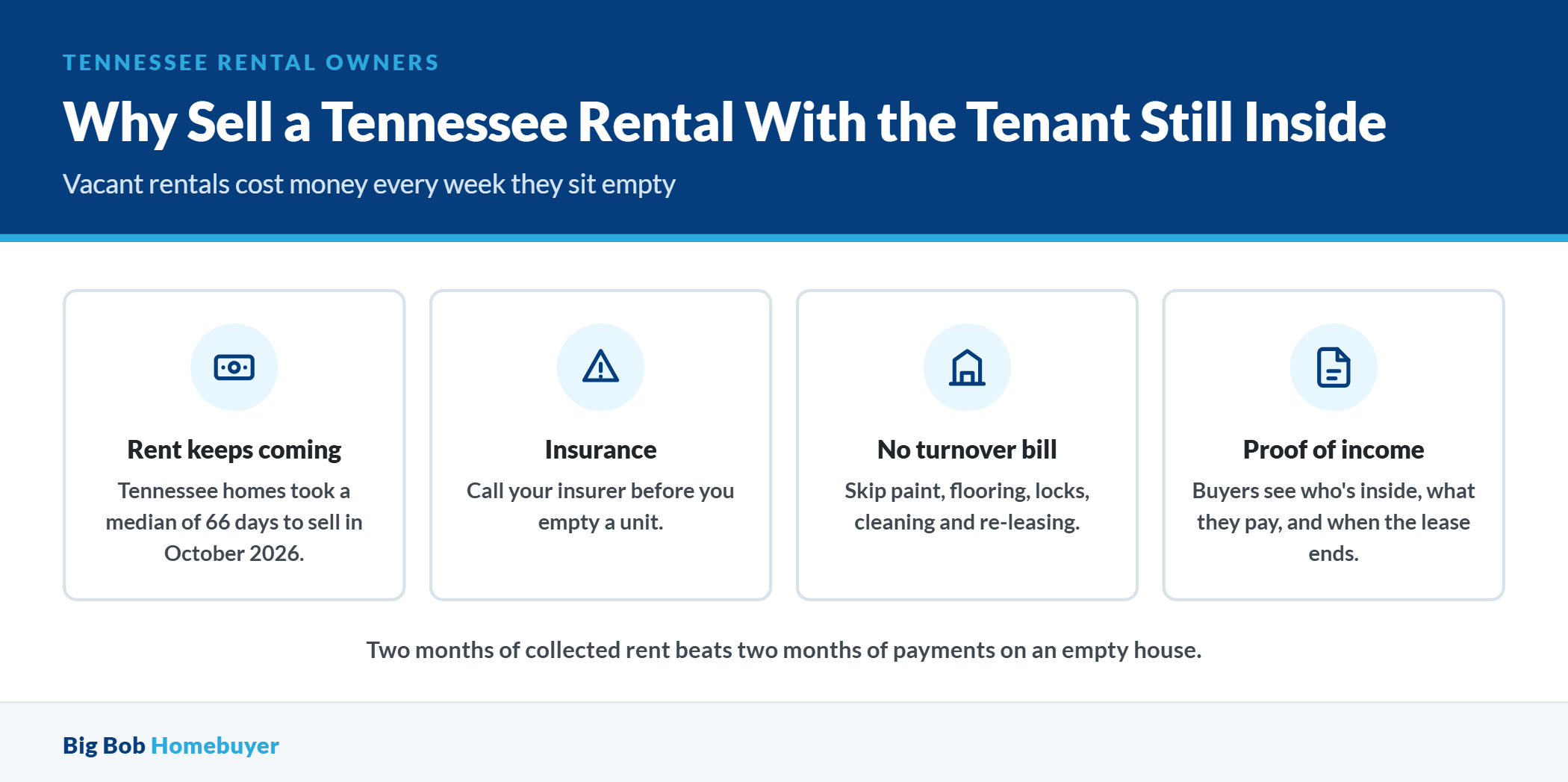
Vacant rentals in Tennessee cost money every single week they sit empty, and insurance is the piece landlords forget. Call your insurance company before you empty a unit.
Cash flow is the better argument anyway. A tenant occupied property in Tennessee keeps producing rent through the entire listing period. That matters when homes in the state took a median of 66 days to sell in October 2026, per Redfin’s Tennessee market data. Two months of collected rent beats two months of mortgage payments against an empty shell.
A buyer looking at Memphis or Clarksville rentals wants proof of income, not a staged living room, and a paying tenant is that proof.
Talk to your accountant about this tax wrinkle. Keeping the unit in service while you market it protects its character as a rental for depreciation purposes, and converting it to a vacant personal-use property mid-sale can complicate that.
Turnover costs real money too. Paint, flooring, locks, cleaning, marketing, and the application process for a replacement renter add up fast in Knoxville and Chattanooga alike. Why spend that on a house you’re about to hand to somebody else?
One more reason sellers overlook: a property with tenants in Tennessee gives the buyer immediate occupancy certainty. They know who’s inside, what they pay, and when the lease ends.
Should You Wait for the Lease to End Before Selling a Tenant Occupied Property?
If your lease ends in six weeks, wait. If it ends in fourteen months, don’t.
It’s the whole calculation, and I’ve watched too many Tennessee landlords split the difference into something expensive. Waiting makes sense when the finish line is close and the local market is moving. Knoxville homes sold in a median of 49 days as of October 2026 according to Redfin’s Knoxville figures, so a lease ending in spring could line up neatly with a vacant summer listing.
Carrying a property for a year while rates move, roofs age, and your situation shifts is a gamble dressed up as patience.
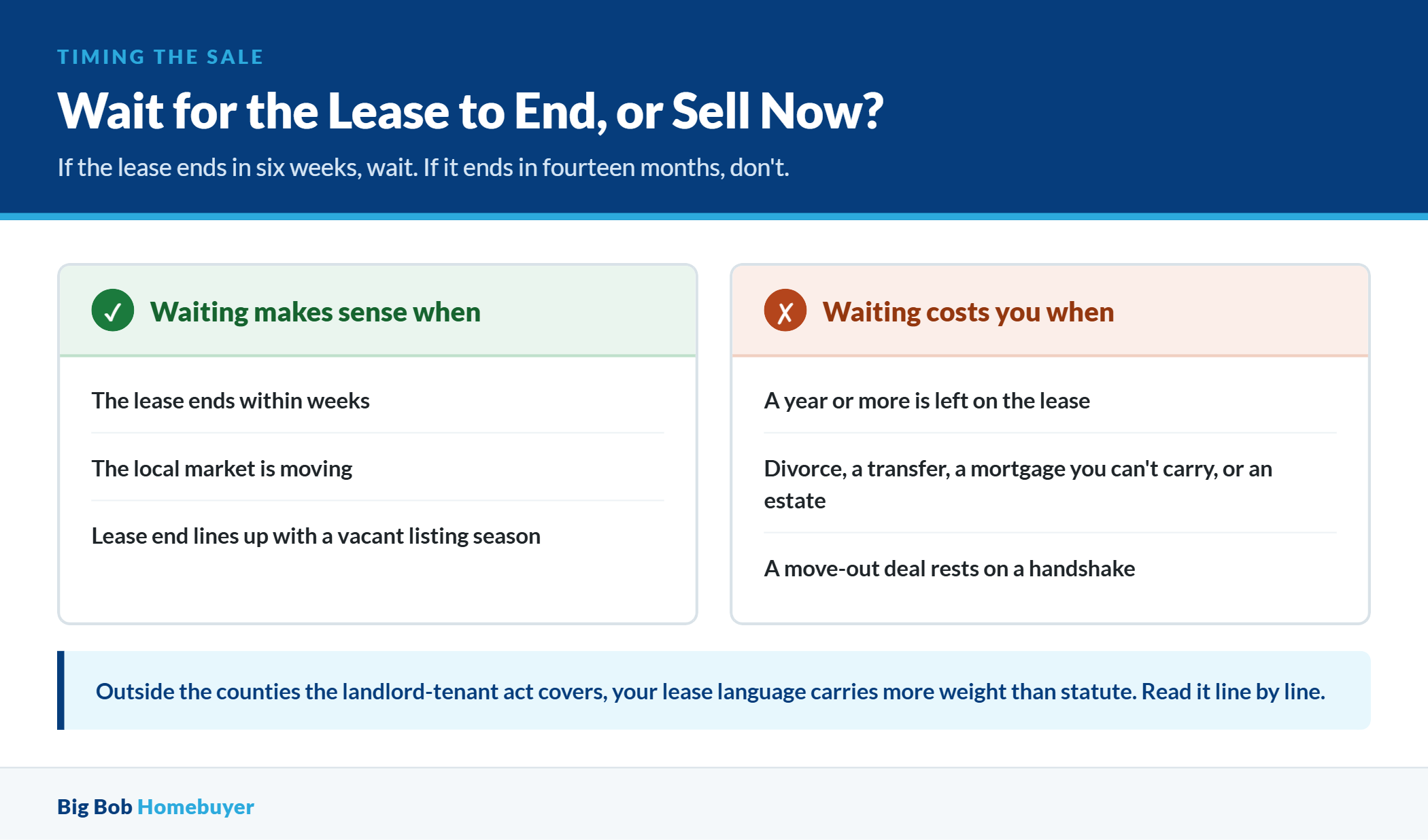
Think about what’s actually driving the sale. Divorce, a job transfer to another state, a mortgage you can’t carry, an estate that needs settling: none of those pause politely for a lease term. A property with tenants in Tennessee can be sold today in those situations, and the lease simply transfers with the deed.
Paying a renter to leave early sounds clean, but the agreement has to be written, voluntary, and signed. A tenant who says yes in March can change their mind before the moving truck shows up. I’ve seen those conversations go sideways often enough that I’d rather structure the sale around the lease than around a handshake.
Rural Tennessee counties deserve a separate note here. Where the Act doesn’t reach, your lease language carries more weight than statute, so read it line by line before deciding anything.
Do Tennessee Tenant Rights Change When the Property Sells?
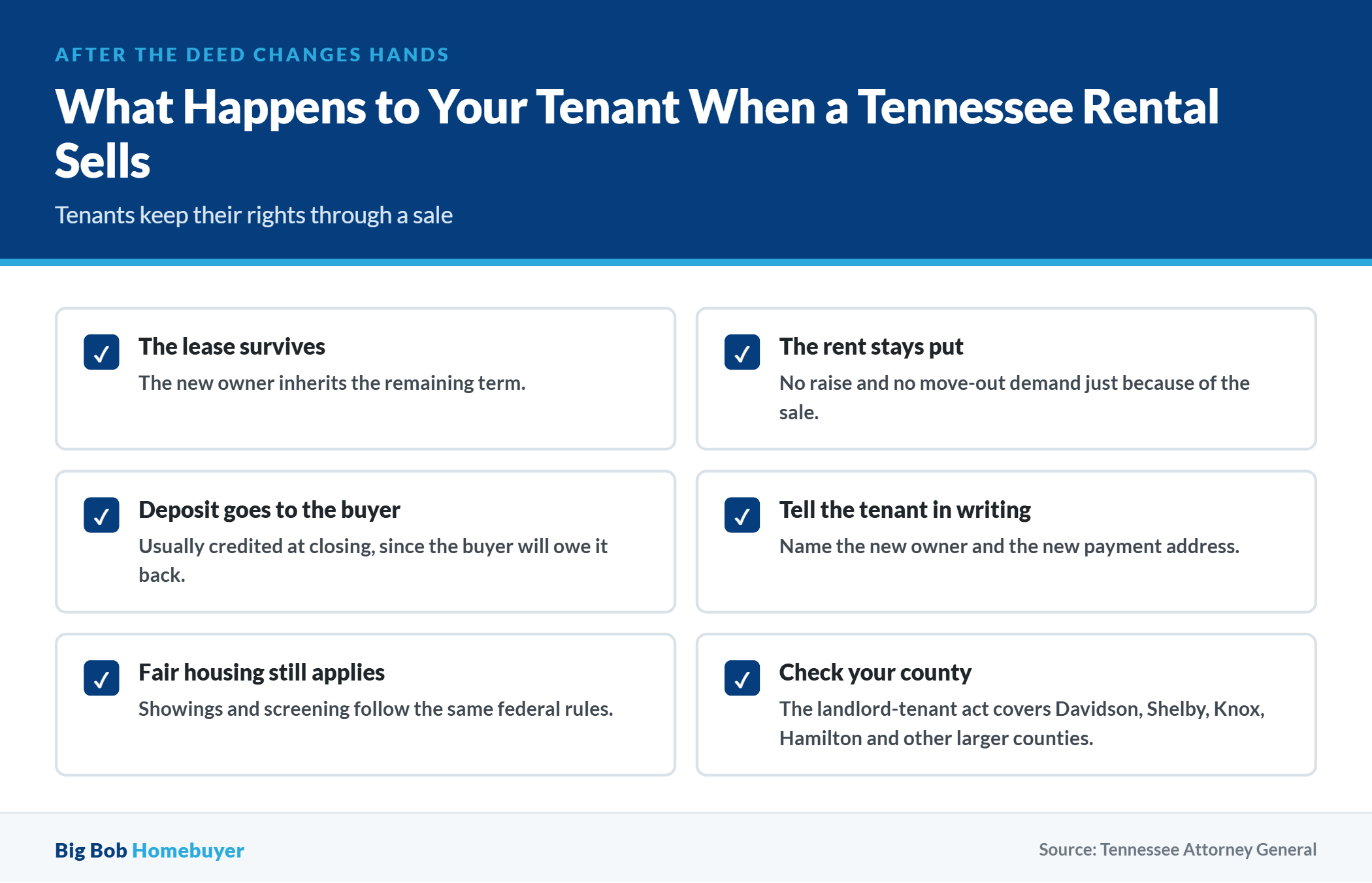
Tenants keep their rights through a sale. The lease survives, the rent stays what it says, and the new owner cannot raise it or demand the renter leave just because the deed changed hands.
Which rules apply depends on where your property sits. The Tennessee Uniform Residential Landlord and Tenant Act only governs counties with more than 75,000 residents in the 2010 federal census, under Tennessee Code section 66-28-102. That covers counties such as Davidson, Shelby, Knox, Hamilton, Rutherford, Williamson, Sumner, Sevier, and Washington.
Security deposits are where closings get messy. That money belongs to the tenant, so it has to be accounted for at closing, usually credited to the buyer who will eventually owe it back. Skipping that step on a property with tenants in Tennessee creates a dispute nobody budgeted for.
Notification isn’t just courtesy. Renters need to know who to pay and who to call when the water heater quits, and a letter naming the new owner and payment address prevents three months of confusion.
Federal fair housing rules apply during the sale, same as always. Nothing about transferring a tenant occupied property in Tennessee suspends those protections, and showings or screening conversations must follow them.
How Do You Sell a House with Tenants Inside?
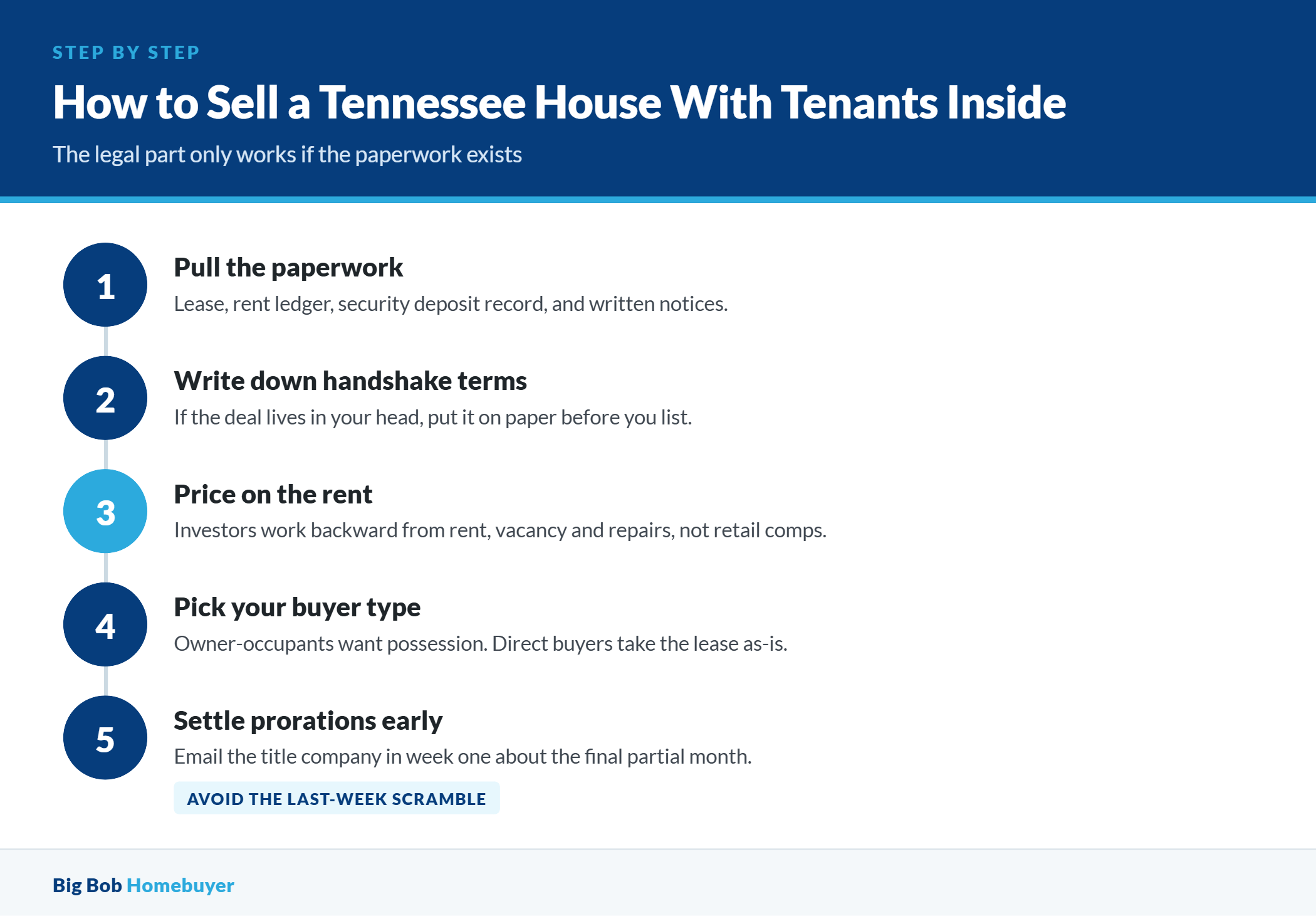
Which brings up the practical sequence, because the legal part only works if the paperwork exists. Pull the lease, the rent ledger, the security deposit record, and any written notices you’ve exchanged, since buyers of a tenant occupied property in Tennessee will ask for all of it during due diligence.
Plenty of Tennessee landlords operate on a handshake with a renter they’ve known for years, and then discover at closing that nobody can prove the terms. Write it down before you list.
Pricing a rental runs on different logic than pricing a primary residence. Retail buyers in Nashville paid a median of $457,000 over the three months ending October 2026, per Redfin’s Nashville data. An investor buying the same block is working backward from rent, vacancy, and repairs, so those two numbers rarely land anywhere close to each other.
Choose your buyer type deliberately. Agent listings reach owner-occupants who usually want possession at closing, which puts your tenant in the crosshairs of the negotiation. Direct buyers and investors take the lease as-is, and that’s often the simplest path for a tenant occupied property in Tennessee with a long remaining term. We handle those at Big Bob Home Buyer without asking anyone to move out.
The last-week scramble over who owes what for the final partial month is entirely avoidable, and a quick email to the title company in week one of the contract usually settles it for good.
How Do You Handle Showings in a Tenant Occupied Home?
Everybody pictures a lockbox on the door and buyers wandering through on a Saturday afternoon.
Tennessee’s access statute is narrower than landlords believe. Under section 66-28-403, the one hard notice requirement is 24 hours before entering during the final 30 days of the rental agreement to show the unit to prospective renters. It applies only if the lease grants that right. For other entries, tenants can’t unreasonably refuse access for inspections, repairs, agreed services, or showings, but the statute doesn’t hand you a general notice schedule. Your lease fills that gap, which is why lease language matters so much on any tenant occupied property in Tennessee.
Give the renter a predictable window instead of random requests. Tuesday evenings and Saturday mornings, say, with 24 hours’ notice as a courtesy regardless of what the statute demands. Offer something real in exchange: a rent credit for the showing month, professional cleaning, or help with a storage unit. In my experience, Tennessee renters who feel respected keep the house presentable, and that’s worth more than any staging budget.
Limit the number of showings. Ten serious investors walking a tenant occupied property in Tennessee is reasonable; forty curious neighbors is not, and pre-qualifying buyers protects everyone’s patience.
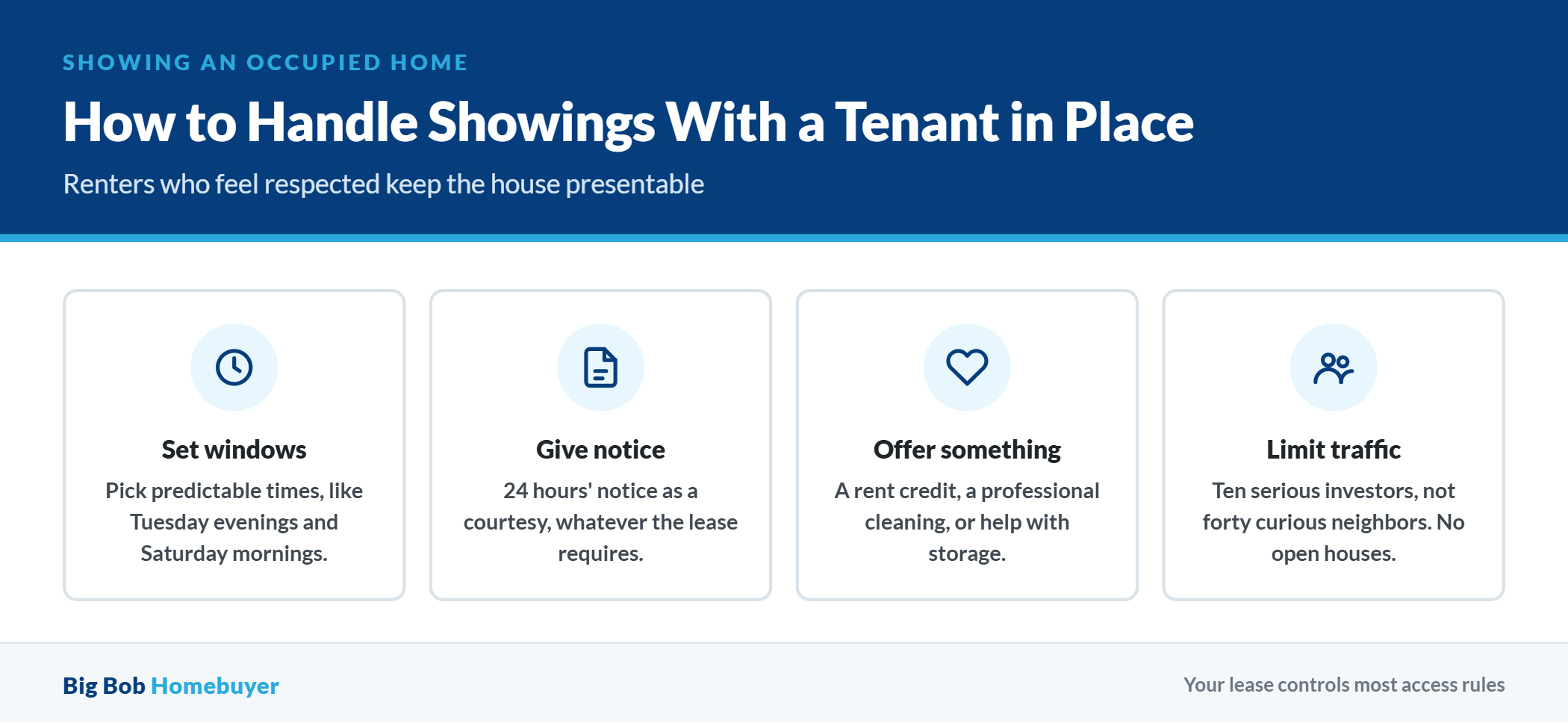
Skip the open house. For occupied rentals in Memphis, Murfreesboro, or anywhere else in Tennessee, open houses generate traffic you can’t control and complaints you can’t undo.
What Happens If Your Tennessee Tenant Won’t Cooperate?
A landlord in Bartlett had a renter who stopped paying in winter and started refusing every showing request. The house sold anyway four months later, occupied, with the rent arrears handled as a price adjustment instead of a court fight.
Eviction in Tennessee is a court process, not a conversation, so it moves at the speed of the General Sessions docket in your county. Filing fees, service, a hearing, and a possible appeal window all stack up before anybody gets possession.
Do the arithmetic before you start evicting. If the process takes two or three months and you’re already carrying a vacancy loss, you may spend more on removal than the vacant-versus-occupied price gap is worth.
A buyer who learns about unpaid rent after closing has a grievance; a buyer who knows going in can price it. Honesty sells a difficult tenant occupied property in Tennessee faster than optimism does.
Never shut off utilities, change locks, or remove belongings to force someone out, because those are illegal self-help measures and Tennessee courts treat them seriously. Call a landlord-tenant attorney before you do anything that feels clever.
Selling as-is sidesteps most of it, since investors buy occupied houses with problem tenancies all the time, discount for the risk, and handle the legal work with their own counsel. Big Bob Home Buyer buys in that condition across Tennessee, no eviction required first, which spares you both the filing fees and the months.
What Do Buyers Need to Know About a Tenant Occupied Property?
Investors evaluating a tenant occupied property in Tennessee care about three documents: the lease, the payment history, and the deposit ledger. Give them those on day one and your offer quality improves immediately.
Below-market rent reduces your price, plainly. A unit renting $300 under market in a Chattanooga neighborhood where comparable rentals command more will be valued on the lease in place, not on what the buyer hopes to charge later.
Financing gets stricter. Conventional owner-occupant loans generally don’t work on occupied rentals, so your realistic buyers are paying cash or using investment loans with larger down payments. That’s part of why the market for a tenant occupied property in Tennessee runs smaller than the market for a vacant one.
Condition still counts. A woman in Collierville reached out while settling her father’s estate, and the garage still held his workbench and about a dozen half-used paint cans. She didn’t want to sort any of it; she wanted the sale handled, the renter left in place, and one closing date she could tell her attorney. We bought it with everything inside and the lease untouched.
Frequently Asked Questions
What Is the Tennessee Uniform Residential Landlord and Tenant Act?
It’s the state statute that spells out landlord and tenant obligations: habitability duties, access rules, deposit handling, and termination notice periods. The catch is that it only applies in Tennessee counties above a population threshold. That covers the major metros and a number of mid-sized counties but leaves many rural ones under common law and the lease itself. Confirm your county’s status with a Tennessee attorney or your local court clerk before relying on any specific procedure.
Does My Tenant Have to Move Out When I Sell?
Not if there’s a fixed-term lease with time left on it, since that lease transfers to the new owner along with the deed. Periodic tenancies are different, and ending one requires the written notice described earlier, served by whoever owns the property at the time. Plenty of buyers prefer the tenant stays anyway.
Can I Raise the Rent Before Selling to Make the Numbers Look Better?
During a fixed term, no, since the rent is whatever the lease says until that term ends. On a month-to-month arrangement in a covered county you can change terms with proper written notice, but a rent increase right before listing tends to invite non-payment and friction at the worst possible moment. Accurate numbers sell a tenant occupied property in Tennessee better than inflated ones.
Do I Need to Give My Tenant Notice Before Showing the House to Buyers?
Your lease controls most of this, because the statute’s single firm notice requirement applies to end-of-tenancy showings to prospective renters. Regardless of the legal minimum, give real advance notice in writing and stick to agreed windows. A tenant who feels blindsided can make an occupied listing nearly unshowable without ever technically breaking a rule.
What Happens to the Security Deposit at Closing?
That money stays the tenant’s money, so it’s typically transferred or credited to the buyer at closing, with the paperwork documenting the amount and the tenant’s name. Your closing attorney or title company should handle it as a line item rather than leaving it to a side conversation. Keep copies of the deposit records.
Is It Harder to Sell a Tenant Occupied Property in Tennessee Than a Vacant One?
The buyer pool is smaller, so it’s different rather than strictly harder. You lose most owner-occupant buyers and gain investors who read leases instead of admiring kitchens, and the price reflects the rent roll more than the finishes. Clean documentation and a cooperative renter narrow that gap considerably.
Can I Sell If My Tenant Is Behind on Rent?
Yes, and you don’t have to evict first. Disclose the arrears, provide the payment ledger, and let the buyer price the risk, since investors who buy across Tennessee handle this regularly. Trying to hide it usually costs more than the unpaid rent did.
What the Memphis Market Means for Rental Owners
Memphis-area home sales reached 1,363 in July 2026, and the median price held almost flat at $240,000, according to the Memphis Area Association of Realtors. Steady prices mean a rental’s value rests on its rent roll and condition, not on a rising tide. That’s true in Shelby County and across the rest of the state.
If your lease, your tenant or your timeline is making the decision hard, the numbers usually make it clearer.
Talk Through Your Rental With Us
If you own a rental here and the situation has gotten complicated, we’re glad to talk it through. Maybe it’s a renter who won’t cooperate, an estate to settle, or a property you’re tired of managing from three states away. We can look at the lease, the numbers, and your timeline, and tell you honestly whether selling occupied makes sense or whether you’d do better waiting. No pressure, no obligation, and no cost for the conversation.
Every lease and every tenant is different. If you’d like help weighing a sale with the tenant in place against waiting for the lease to end, contact Big Bob Home Buyer and we’ll go over the numbers with you. You can also fill out the short form below to get a no-obligation cash offer on your Tennessee rental.
Helpful Tennessee Blogs
- Selling a House with Unpermitted Work in Tennessee
- Selling a House During Divorce in Tennessee
- Who Pays Closing Costs When Selling a House in Tennessee
- How to Sell a Tennessee House with Title Problems
- Can You Sell a House with a Lien on It in Tennessee
- How Long Does It Take to Sell a House in Tennessee
- Selling Tenant Occupied Property in Tennessee