A seller in Antioch once called me sure she’d walk away with her full asking price, minus the agent’s cut. She’d forgotten the title work. She’d also missed the prorated property taxes and a repair credit the buyer asked for three days before closing. Closing costs in Tennessee live right there, in the space between the price on the sign and the number on your wire transfer.
Most sellers here end up carrying more of the settlement sheet than they guessed. Three things decide the split: local custom, state statute, and whatever got written into the contract. They don’t always agree with each other. You’re better off learning your closing costs before you list than finding them at the title company table.
What Does It Cost to Sell a Home in Tennessee?
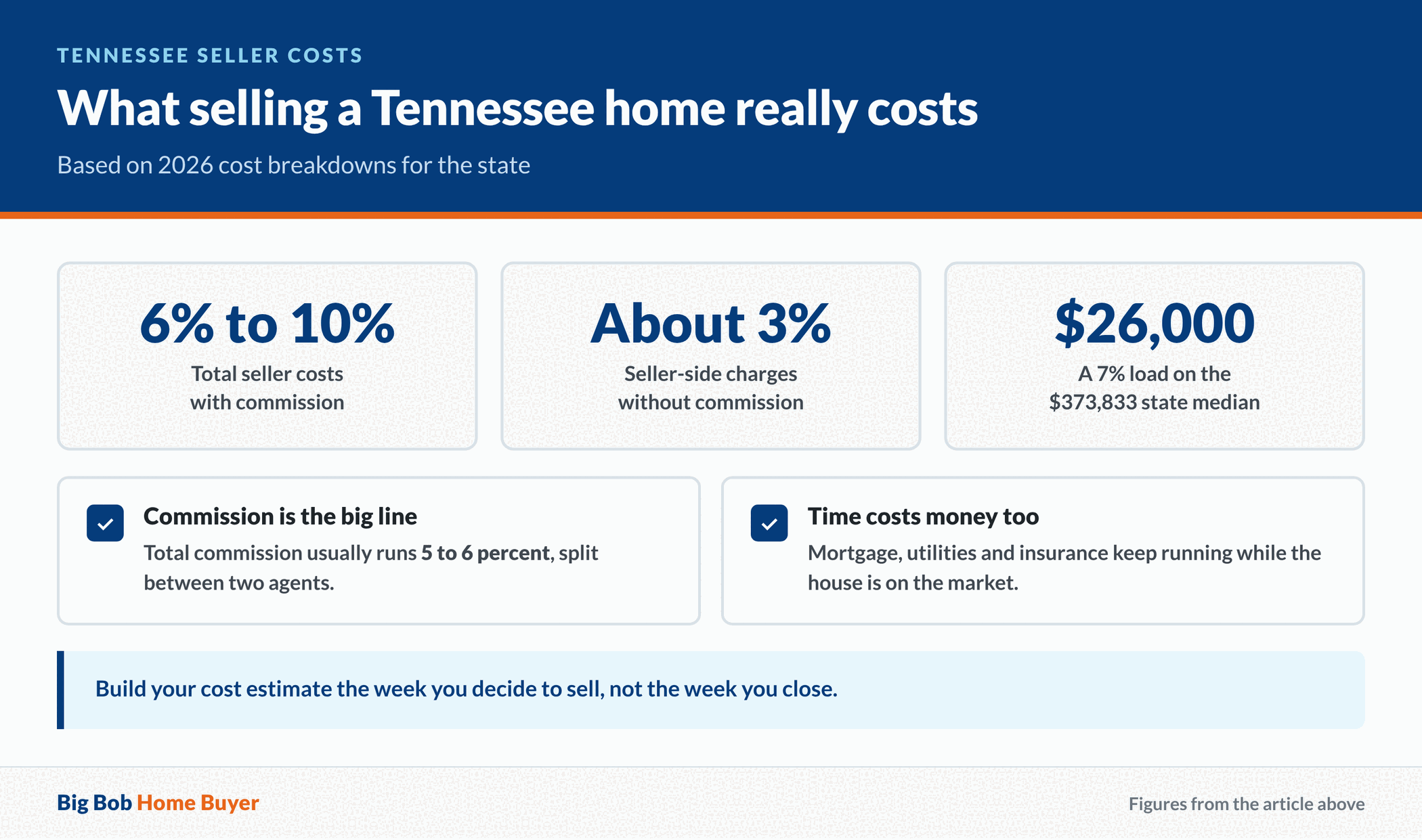
That gap usually runs wider than a napkin estimate. Fold in agent commissions and sellers in Tennessee commonly watch somewhere between 6 and 10 percent of the sale price vanish before the wire lands, according to 2026 cost breakdowns for the state. Take the commission out and the rest of the seller-side charges land closer to 3 percent of the selling price on average.
Put real numbers on it. Tennessee’s median sale price was $373,833 in September 2026, a hair lower than a year before. At that level, a 7 percent total load takes roughly $26,000 off the top. That isn’t a rounding error. It’s the down payment on your next place.
Location changes the math, too. Greater Nashville REALTORS reported a median single-family price of $499,990 for October 2026, so a Davidson County seller pays commission on a much bigger base than someone in Johnson City or Jackson.
Time costs money, and you’ll never see that line on a settlement statement. Knoxville homes took an average of 49 days to sell over the three months ending October 2026. That’s before the inspection, appraisal, and lender underwriting even start. Add those and you’re paying the mortgage, utilities, and insurance for another month or two.
How Much Are Closing Costs in Tennessee?
A lot of sellers expect closing costs in Tennessee to show up as one number on one line. The settlement statement disagrees. You’ll get a column of a dozen separate charges, some flat, some tied to your price, and a few the buyer’s lender dreams up in the last two weeks before closing.
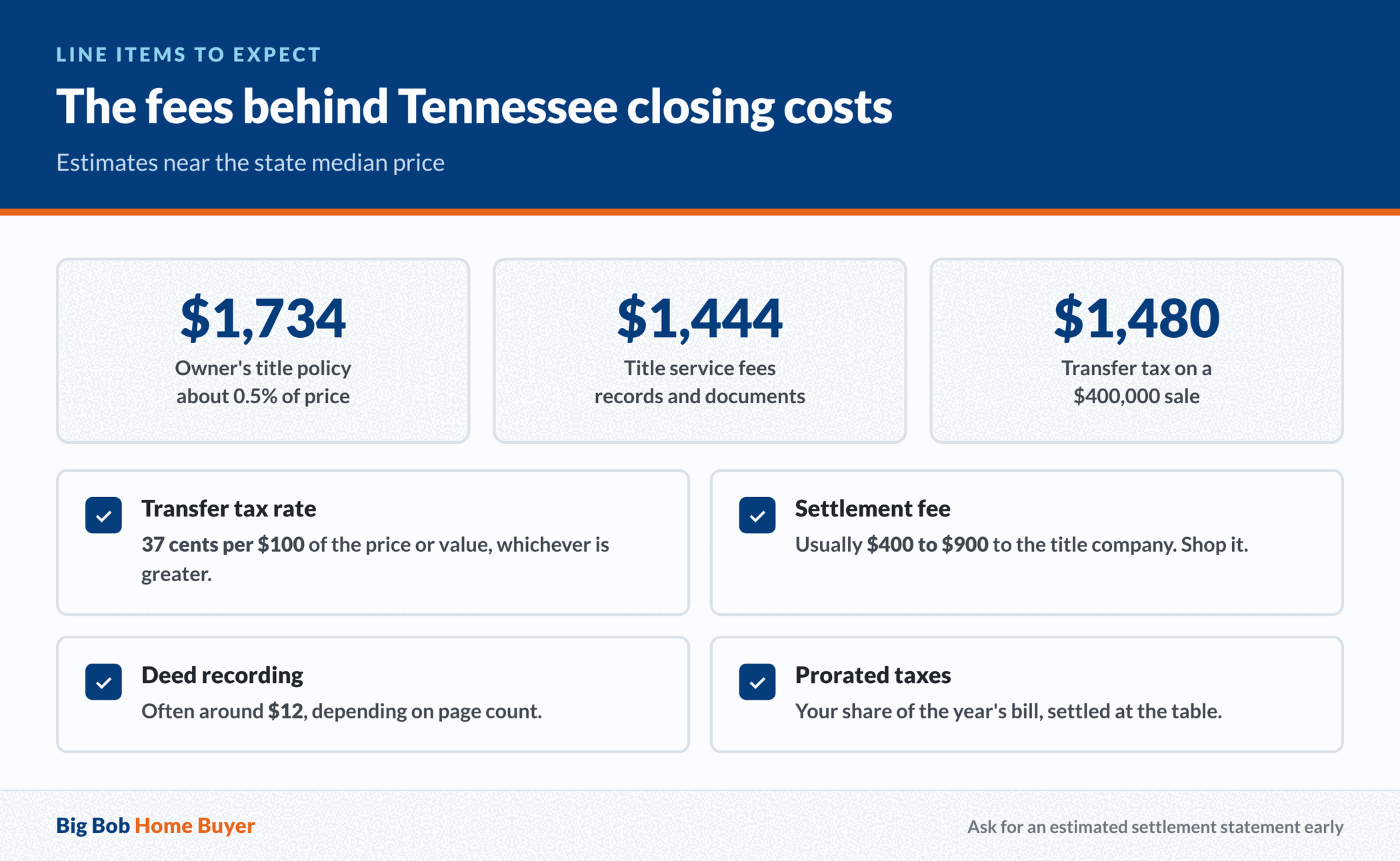
The scaled charges sting most. Owner’s title insurance in Tennessee generally runs around half a percent of the final price, or about $1,734 on a home near the state median. Title service fees cover pulling records and preparing documents, and they typically add around $1,444. Together that’s three thousand dollars gone before anyone mentions commission.
Next comes the state’s cut at recording. Tennessee’s realty transfer tax hits every transfer of real property at 37 cents per $100. It’s figured on whichever is greater, the amount paid or the property’s value, per the Department of Revenue’s recordation tax guidance. A $400,000 sale pays $1,480.
This is the part plenty of Tennessee sellers get backward.
Department of Revenue guidance puts the legal responsibility for that transfer tax on the grantee, meaning the buyer named on the recorded deed. Even so, lots of local practice and lots of online guides say the seller pays it. Both can hold in the same transaction, since statute assigns the duty and your purchase contract can move who funds it. Ask your closing attorney how your agreement reads instead of guessing.
Buyer-side closing costs in Tennessee aren’t small either. One 2026 analysis put the average buyer’s total at about 3.63 percent of the purchase price. Why should you care? A buyer stretched thin on their own costs tends to ask you to pick some of them up.
Who Pays the Closing Costs in Tennessee?
Picture a Murfreesboro seller who signs a contract at $420,000 and plans her next move around that number. Forty-one days later she wires $27,000 to the title company and nets far less than she’d figured.
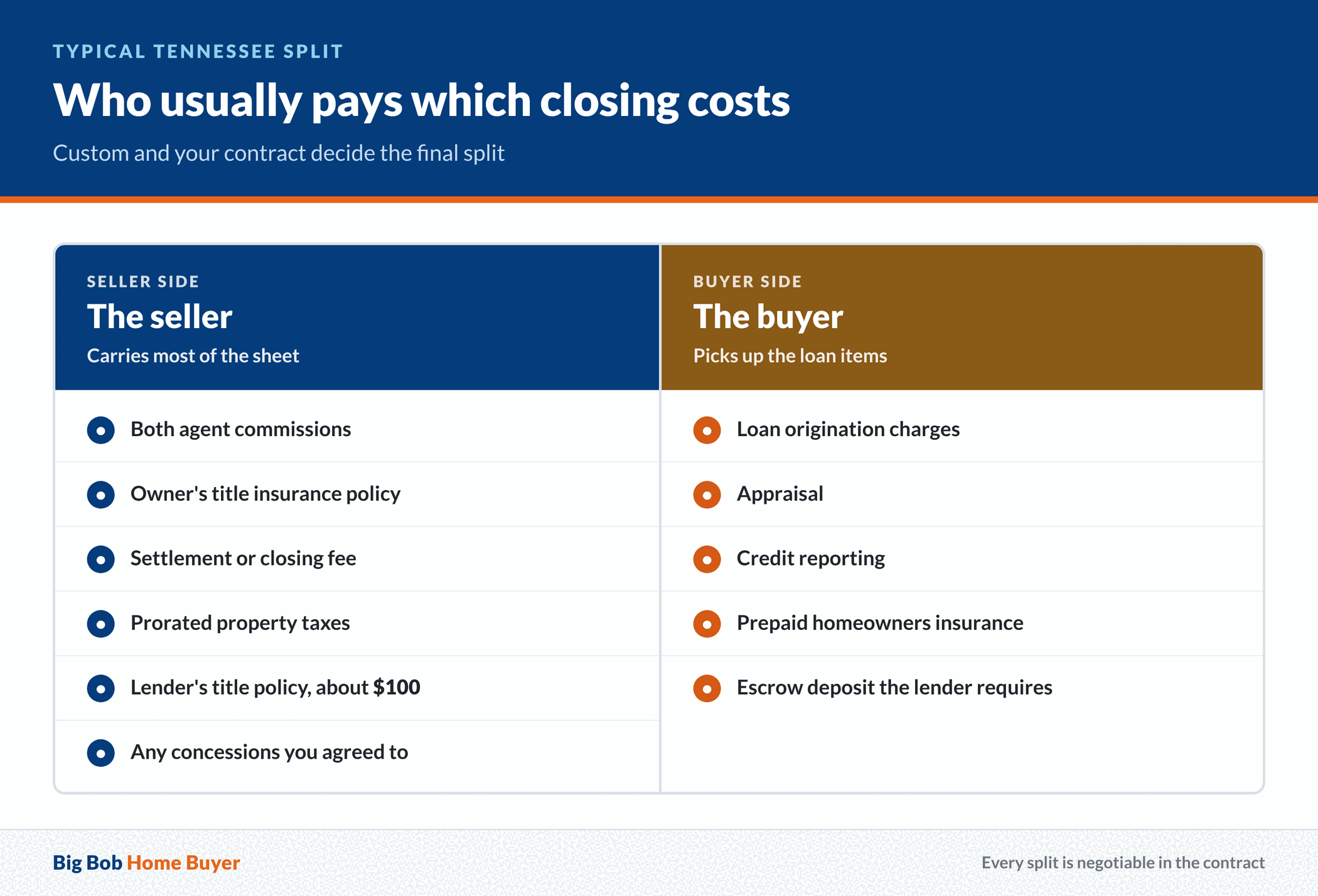
Nothing went wrong there. That’s the normal division of closing costs in Tennessee. Usually, the seller here is responsible for most of the closing costs, though not every single line.
Your column usually holds both agent commissions, the owner’s title policy, and the settlement or closing fee paid to the title company. It also carries prorated property taxes for the part of the year you owned the home, plus any concession you agreed to. Tennessee is a little odd on one item. Sellers here often pay for the lender’s title insurance too, roughly $100 at median price points.
Loan items go to the buyer. Origination charges, the appraisal, credit reporting, prepaid homeowners insurance, and the escrow deposit their lender wants all land on their half of the sheet.
Does it have to split that way? No. You can negotiate for the buyer to take on more of the closing costs, and some sellers swap a price cut for exactly that. Tennessee had 49,943 homes listed in September 2026, up sharply year over year. With that much choice, buyers push, and sellers tend to give up more than they planned.
Selling straight to an investor changes the whole picture. Most of us who buy houses outright pay the standard closing costs ourselves, and there’s no commission because there’s no agent. Big Bob Home Buyer works that way across Tennessee, and it’s worth holding that up against a listing estimate before you commit to one path.
What Do Real Estate Agent Commissions Cost in Tennessee?
“Can’t I just pay my listing agent and skip the buyer’s side?”
You can ask. Buyer’s agents in Tennessee still expect to get paid, though, and most buyers won’t cover that out of pocket on top of their own closing costs. Total commission in Tennessee’s 2026 market generally runs 5 to 6 percent of the sale price, split between the two agents.
On a half-million-dollar Williamson County house, six percent is thirty thousand dollars. That’s a full kitchen remodel paid to two people for about sixty days of work.
The rate has always been negotiable, and the 2024 industry settlement just made that clearer. Flat-fee brokerages and discount listing services work all over Tennessee. Some full-service agents will also drop half a point on a higher-priced property without much of a fight.
How much leverage you have depends on the pace of your market. Across Middle Tennessee in October 2026, homes averaged 38 days on market, up from 33 a year earlier, with a little over five months of supply. When homes move slower, agents want listings, and agents who want listings bargain.
I see one pattern over and over. Sellers obsess over trimming the commission and ignore the concession line. I’ve watched people argue for weeks over a half point of commission, then hand the buyer a $9,000 credit after the inspection without a second thought. Both numbers come out of the same pocket.
Strictly speaking, commission isn’t part of closing costs in Tennessee; it sits on its own line of the settlement statement. In practice it’s the biggest check you’ll write at the table, so any honest talk about closing costs has to include it.
What Other Fees Get Rolled Into Closing Costs?
“Sure, but those little fees can’t add up to much, can they?”
They add up to a few thousand dollars, and you can dodge some of them if you spot them early. Deed recording fees really are small, often around twelve dollars depending on page count, according to 2026 Tennessee seller cost data.
Prorated property taxes need your attention because hardly anyone budgets for them. You owe your share of the year’s bill for the months you owned the place, settled at the table. Sell in October and you’re paying for roughly ten months.
Your mortgage servicer’s payoff statement sometimes tacks on an administrative fee. Push back. It’s often waivable, and it’s rarely disclosed until the payoff demand shows up.
The settlement or closing fee goes to whichever title company handles your transaction, usually falling in the $400 to $900 band. Shop around. Title companies in Memphis charge differently than ones in Kingsport, and you don’t have to use the first one your agent names.
HOA transfer and document fees surprise owners in condo-heavy spots like downtown Nashville and the Gulch. Associations bill for estoppel letters and resale certificates, and the amounts vary across Tennessee. Get yours in writing the same week you go under contract.
Attorney fees appear in most Tennessee closings, since attorneys commonly run them. Home warranty premiums, survey costs, termite letters, and post-inspection repair credits fall on the seller in some transactions and on the buyer in others. Each one is a contract term, not a law.
Would you rather learn about these before you price your house, or after? I’d pick before. Build a cost estimate the week you decide to sell, not the week you close.
What Is Title Insurance and Who Pays for It?
Why pay for this closing cost when you’ll probably never file a claim? Title insurance is the one closing cost that looks like a ripoff right up to the day it rescues your sale.
It covers defects in the ownership chain: an unreleased lien from a contractor in 1998, a forged signature, a missing heir, a boundary dispute that got recorded wrong. Title service fees pay for the public records search before ownership changes hands, which confirms no claims or liens sit against the property. If that search misses something, the policy pays.
There are two policies. The owner’s policy protects the buyer’s equity. The lender’s policy protects the bank holding the mortgage, and it only covers the loan balance.
Custom in Tennessee leans toward the seller buying the owner’s policy for the buyer, which is the common arrangement here and catches people off guard if they’ve sold houses in other states. In effect you’re buying protection for someone else and vouching that you’re handing over clean title.
Older homes make this more than paperwork. Think East Nashville bungalows, Victorian properties in Jonesborough, or farmhouses in Maury County. They come with long ownership chains, old easements, and now and then a deed recorded by hand in a ledger book. A clean title search on a 1920s property is real work.
In my experience, inherited property is where title issues surface most often. A parent passes, nobody updates the deed, the siblings assume probate covered it, and then the title company finds a gap. Fixing that adds weeks and can take a quiet title action.
Can you negotiate the premium? Usually not the underwriting rates, but you can negotiate who pays. If buyers are competing in your part of Tennessee, asking them to take the owner’s policy is reasonable, and it cuts your closing costs by a thousand dollars or more.
How Can You Reduce Your Closing Costs in Tennessee?
For years I told sellers the way to cut closing costs was to fight hard at the table. I had it wrong; nearly all of it gets decided the day you sign the contract.
Start with commission, because it’s the biggest number. Half a point off a $450,000 sale puts $2,250 back in your pocket. Ask before you sign the listing agreement, not after.
Compare title companies. Settlement fees and title service charges differ from one provider to the next, and the savings on closing costs in Tennessee are real even though nobody advertises them.
Hold off on offering concessions up front. Sellers list, get jittery after two quiet weeks, and start promising “$10,000 toward buyer closing costs” before anybody asked. Wait until you have an actual offer in hand.
Pricing correctly beats every fee trick put together. Nashville’s median sale price over the three months ending October 2026 was $457,000, down 3.8 percent year over year, and homes in the city averaged 66 days on market. A house that sits four months racks up carrying costs far bigger than anything you’d save arguing over a settlement fee.
Ask for your estimated settlement statement early. Title companies will draft a preliminary one a few days before closing if you request it, and mistakes do show up. More than once I’ve caught duplicate charges, or fees billed to the wrong side.
Selling as-is to a direct buyer wipes out several categories in one move, including commission, staging, repair credits, and months of carrying costs. You’ll trade some price for that, and anyone who says otherwise isn’t being straight with you. Whether the trade works comes down to your equity, your timeline, and what the other route really nets once closing costs in Tennessee come out.
How Do You Calculate Your Net Proceeds After Closing Costs?
Your mortgage payoff almost never matches the balance on your last statement. It adds interest through the closing date and any recording fee for the release, so request an actual payoff quote instead of trusting the number in your app.
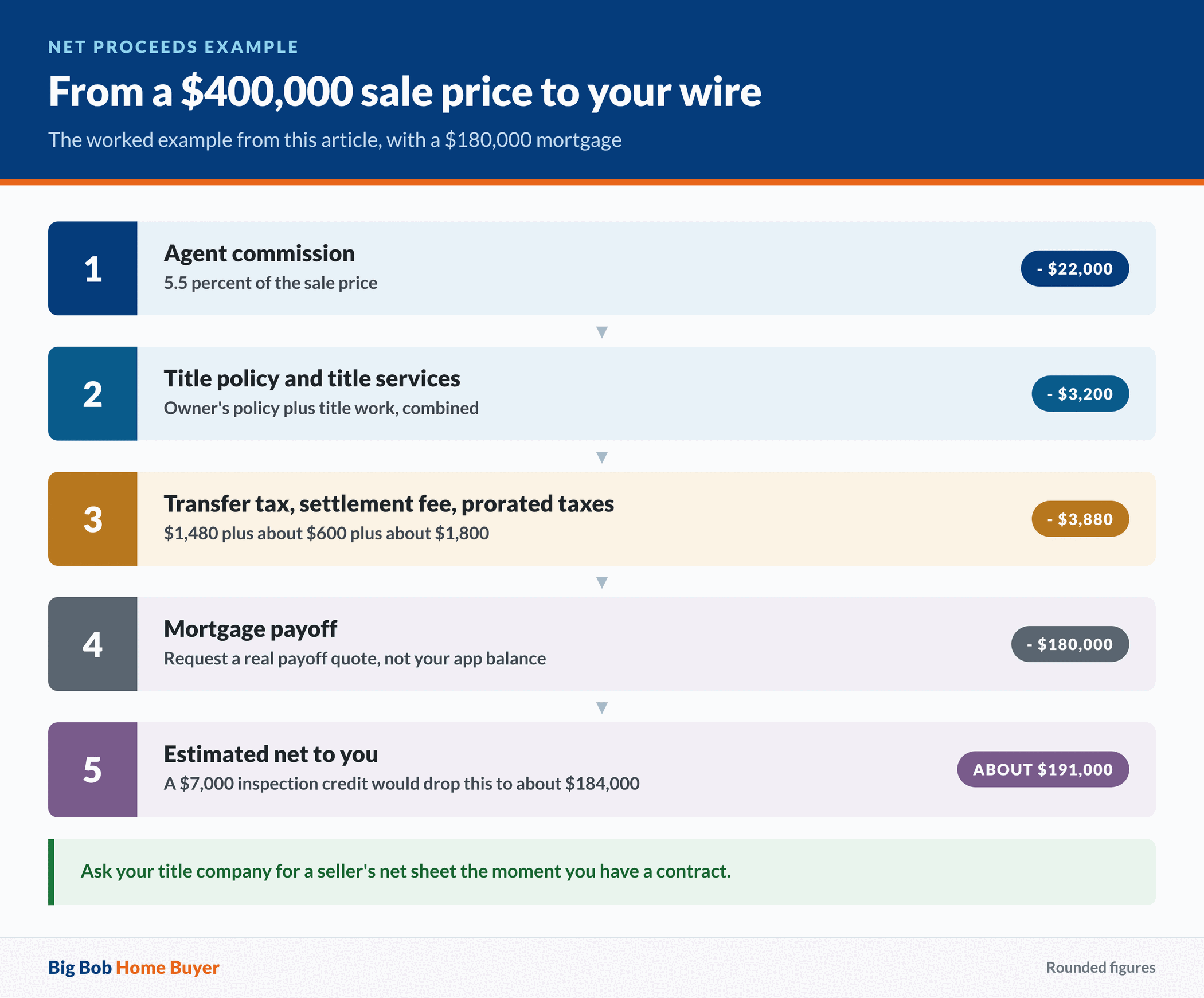
Work the calculation in order. Take off the payoff first, then commission, then title and settlement charges, then prorated taxes. After that, subtract the transfer tax if your contract puts it on you, and then any concessions. Whatever’s left is your wire.
Here’s a real example. Say you’re selling in Tennessee with a $180,000 mortgage. Commission at 5.5 percent is $22,000, the owner’s title policy and title services come to roughly $3,200, and the transfer tax is $1,480. Figure about $600 for the settlement fee and maybe $1,800 in prorated taxes. Take all that off the price, then the mortgage, and you’re near $191,000. A $7,000 inspection credit pulls it down to $184,000.
Plan for capital gains, too. The federal exclusion covers up to $250,000 of gain for a single filer and $500,000 for a married couple filing jointly. You need to have owned and lived in the home two of the last five years, and investment properties don’t qualify. Attorney fees and other seller-side closing costs in Tennessee generally lower your taxable gain, so hang on to every settlement statement.
Ask your title company for a seller’s net sheet as soon as you have a contract. If anything in the contract changes, ask for a fresh one.
Frequently Asked Questions
What Costs Should a Tennessee Seller Expect at the Closing Table?
Expect both agent commissions, the owner’s title insurance policy, the title company’s settlement fee, prorated property taxes through closing day, and any concessions in your contract. Tennessee sellers also commonly cover the lender’s title policy, which isn’t true in most states. Your closing attorney or title company can hand you a net sheet listing every charge on your transaction.
Does the Buyer or the Seller Carry the Bigger Share of Closing Costs?
In nearly every traditional Tennessee sale, the seller carries more, mainly because agent commissions sit on that side of the settlement statement. Buyers pay for their loan origination, appraisal, inspection, and prepaid escrow items. No law fixes the split, though, and a motivated seller in a slow market often absorbs part of the buyer’s share.
Are Closing Costs Different If My Buyer Uses a Big National Lender?
Lenders’ own fees vary, but your side of the settlement statement barely moves based on who finances the buyer’s loan. Origination charges, underwriting fees, and rate-lock costs stay with the buyer whichever lender they pick. Where it can touch you is when a lender demands repairs or extra paperwork, which can push the timeline and add to your carrying costs.
Can I Sell Without Paying Any Closing Costs in Tennessee?
Not entirely, because somebody has to pay the state’s recording tax and the title work. You can come close by selling directly to a buyer who covers those items and charges no commission. Compare that offer with your net after a traditional listing, not with the list price, since those two numbers are far apart.
If you’re weighing a listing against a direct sale and want someone to run the math with you, we’re glad to help. There’s no pressure, no obligation, and no hard feelings if listing turns out to be the better fit for you.
Selling a House in Memphis and Across Tennessee
Closing costs hit differently in Memphis, where prices sit well below the state median. Zillow put the typical Memphis home value at $151,794 in September 2026, down 2.8 percent from a year earlier. On a house at that price, a few thousand dollars in fees eats a bigger share of your equity.
That’s why it helps to price out every path before you list. Big Bob Home Buyer covers the standard closing costs when we buy, and we buy houses in Tennessee from Memphis to the Tri-Cities.
Talk Through Your Closing Costs With Us
If you’d like a second set of eyes on your numbers, we’re happy to compare a listing estimate with a cash offer for your house. Reach out to Big Bob Home Buyer or fill out the form below, and we’ll walk you through what you’d actually take home.