
The title search is where the truth comes out. Most Tennessee sellers breeze through one without a second thought. Then a title officer calls about a roofing contractor from 2019, or a credit card judgment nobody remembered. The sale doesn’t die. It slows down, and somebody starts paying for the delay. I’ve bought houses across Middle Tennessee for years, and a lien turns up in the file more often than people outside the business would guess.
What Is a Lien on a House in Tennessee?
Say you just accepted an offer, and then you learn a contractor filed a claim against the property years back. A lien isn’t a punishment; it’s a receipt saying somebody else gets paid from your money before you do.
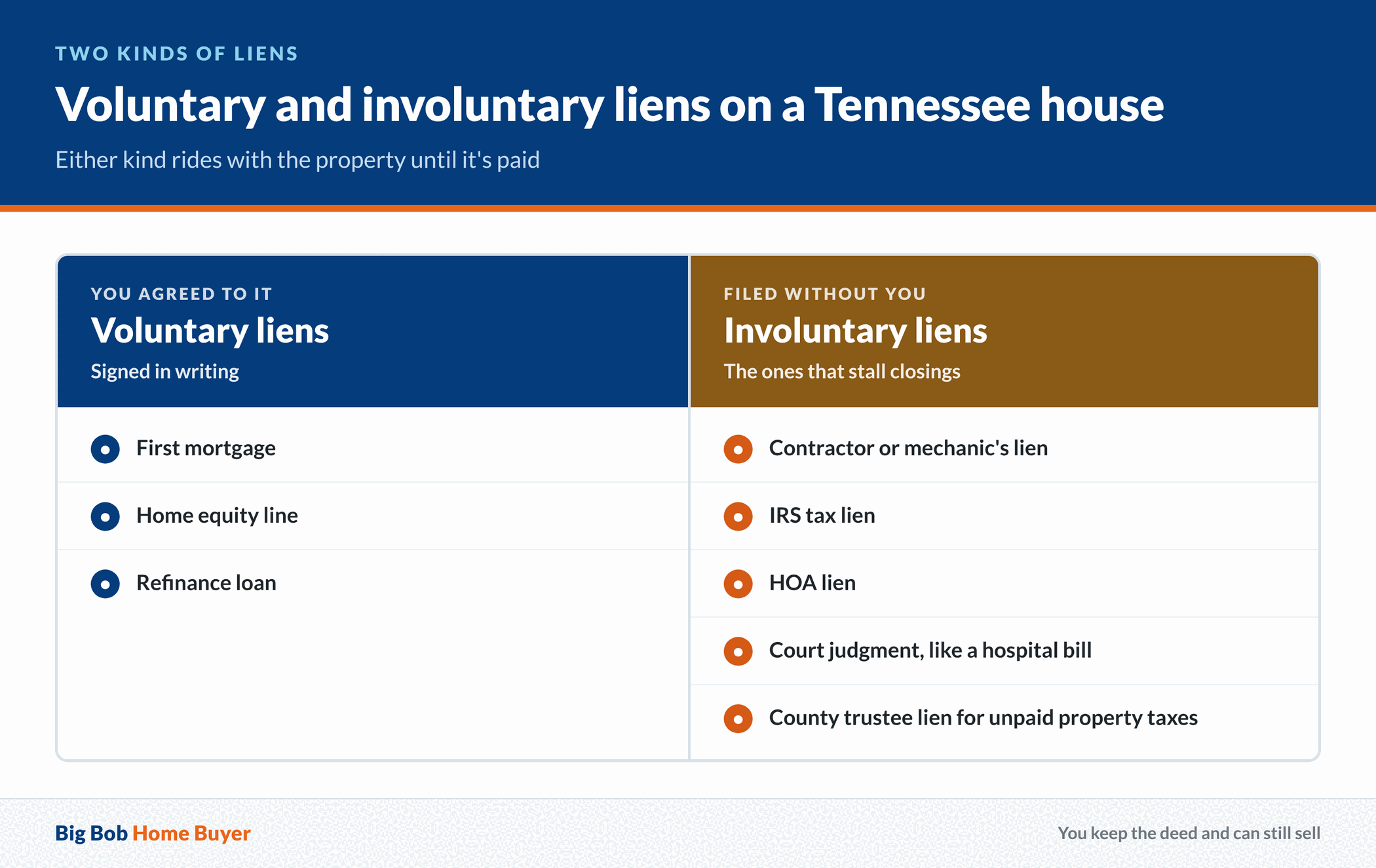
Think of your house as a stack of cash sitting in the county records. Every lien in Tennessee is a sticky note on that stack showing who gets paid first, and your mortgage lender stuck the biggest note there on closing day. A contractor who roofed your place in Murfreesboro can add one. The IRS can too, along with your HOA, a hospital holding a judgment, or the county trustee over unpaid property taxes.
Voluntary liens are the ones you agreed to. Your first mortgage, a home equity line, and a refinance are all liens you signed for in writing. Involuntary liens land on your real property without your signature, and those are the ones that wreck closings.
One family I worked with hadn’t opened the mail stacked in their garage for months. In that pile sat a contractor’s lien from a bathroom remodel they never knew had gone unpaid.
A lien lives in the register of deeds office for the county where the property sits. In Tennessee, that county register of deeds office is the official filing cabinet for documents affecting real property. It’s also the first place a title search in Tennessee goes looking.
Plenty of homeowners get tripped up on this: it doesn’t take your ownership away. You still hold the deed, and you can still sell. It just rides along with the property until somebody satisfies it.
What Does Tennessee Lien Law Say?
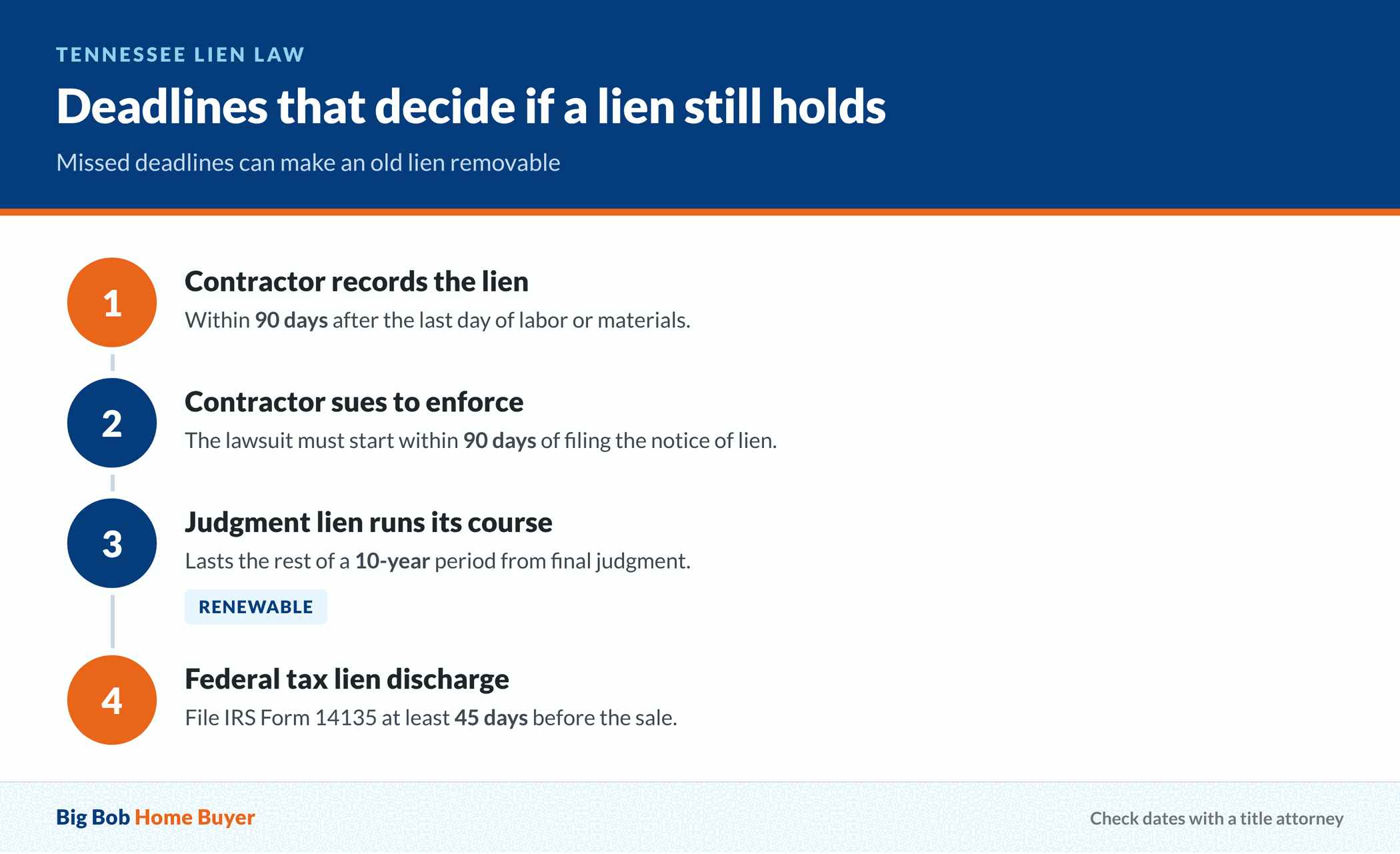
Ninety days. That number decides more Tennessee lien fights than any other, and it comes from the state’s mechanic’s claim statute.
A sworn statement gets recorded in the register of deeds for the county where the property is located within 90 days after the last day of furnishing labor or materials. On residential jobs, contractors file it and serve the owner with notice soon after completion or abandonment, or within 10 days of a filed notice of completion. Butler Snow’s attorneys walk through the full deadline sequence for Tennessee construction liens. After recording, the lawsuit to enforce the lien has to start within 90 days of filing the Notice of Lien.
Judgment liens run on a separate track in Tennessee. A judgment lien attaches to real property once a certified copy of the judgment is registered in the register’s office of the county where the land sits. It lasts for whatever’s left of a ten-year period from the date the final judgment was entered in the court clerk’s office. You can read the Tennessee rule on execution against realty yourself on the state courts site.
Every decade, a judgment holder can ask to extend the judgment for ten more years.
Does any of this mean these claims last forever? No. People miss deadlines all the time. Contractors blow the filing window, and creditors forget to renew. A claim sitting in the Davidson County records since 2008 may already be dead weight that a title attorney can clear with a letter.
Can You Sell a House with a Lien in Tennessee?
Ignore a recorded lien and you’ll end up at a Tennessee closing table watching a wire get held while everyone looks at you. That’s the real cost. It isn’t legal trouble, just a delay that wears out your buyer’s patience and your rate lock.
So yes, you can absolutely sell a house with one in Tennessee. It happens every week across this state. The matter simply has to be resolved before or during closing, because Tennessee buyers using a mortgage need clear title, and their lender won’t fund a loan that sits behind a stranger’s claim.
Most of the time, the lien comes off the top of your proceeds at closing. Your title company works out the payoffs, wires each lienholder, records the releases, and you leave with what’s left.
Equity decides almost everything here. In September 2026, the median Tennessee home sold for $373,833, according to Redfin’s statewide market data. Most owners at that price who’ve held a few years can absorb a lien and still walk away with real money.
It gets uncomfortable when your mortgage plus liens add up to more than the house will bring.
I’d push back on the usual advice to wait until you can clear it before listing. Interest keeps piling onto most lien balances the whole time you wait. Selling and settling the debt from proceeds usually costs less than holding the property another year.
How Does a Lien Affect Your Home Sale in Tennessee?
Before: a seller in East Nashville has a signed contract, a financed buyer, and a three-week closing. After the title search: a hospital judgment turns up, closing slides five weeks, and the buyer’s rate lock runs out.
That’s the practical damage it does in Tennessee. You don’t lose ownership. You lose time, and some sales fall apart because of it.
Buyers in this market care more about timing than they did two years ago. Greater Nashville REALTORS reported 2,540 closings in October 2026, with single-family homes averaging 61 days on the market and a median residential price of $499,990. Two months of marketing plus a lien delay can push you into a slow season when fewer buyers are out looking.
The money moves, too. Every lien payoff shrinks your net, since a lienholder who hasn’t seen a check in years may tack accrued interest and service charges onto the principal. Sellers who only remember the original debt are often shocked by those numbers.
Buyers react to liens with their gut, not only their wallet. I’ve seen Tennessee buyers walk away from a perfectly good house because the title commitment listed three exceptions and they decided the seller was hiding something. A title that looks clean matters almost as much as one that is.
Your real estate agent can’t fix that, by the way. Agents market houses. Clearing a lien in Tennessee takes a closing attorney, a title examiner, or a direct buyer who handles it in-house.
When did you last check your own title? Most homeowners never do until a contract forces the issue, and a $30 search at the register of deeds would’ve bought them six months of lead time.
What Are Your Options for Dealing with a Home Lien?
If you have the cash, paying the lien outright is the cleanest route. The lienholder signs a lien release, it gets recorded in the county where your Tennessee property sits, and the title stays clear from then on.
Negotiating the balance down works more often than people expect. Creditors sitting on an old judgment against a Tennessee house will frequently take sixty or seventy cents on the dollar for a sure payoff at closing.
Disputing an invalid lien is the option sellers overlook. Maybe a subcontractor missed the recording window, the amount is wrong, or the work never got finished. In any of those cases, that lien can be challenged and removed.
You can also sell as-is to a buyer who’s handled liens before. We take care of payoffs and releases as part of the transaction all the time. That’s a big reason homeowners call Big Bob Home Buyer after a title issue has already sunk one sale.
Federal tax liens follow their own path. Form 14135 asks the IRS to release one specific property from a federal tax lien, so the property can sell with clear title without you paying the whole tax debt first. The IRS covers the discharge process and related forms on its own site.
A refinance can clear a lien as well, if your credit and income back it up. For most of the struggling Tennessee sellers I meet, they don’t, and chasing a refinance burns three months.
What Are the Steps to Sell a House with a Lien?
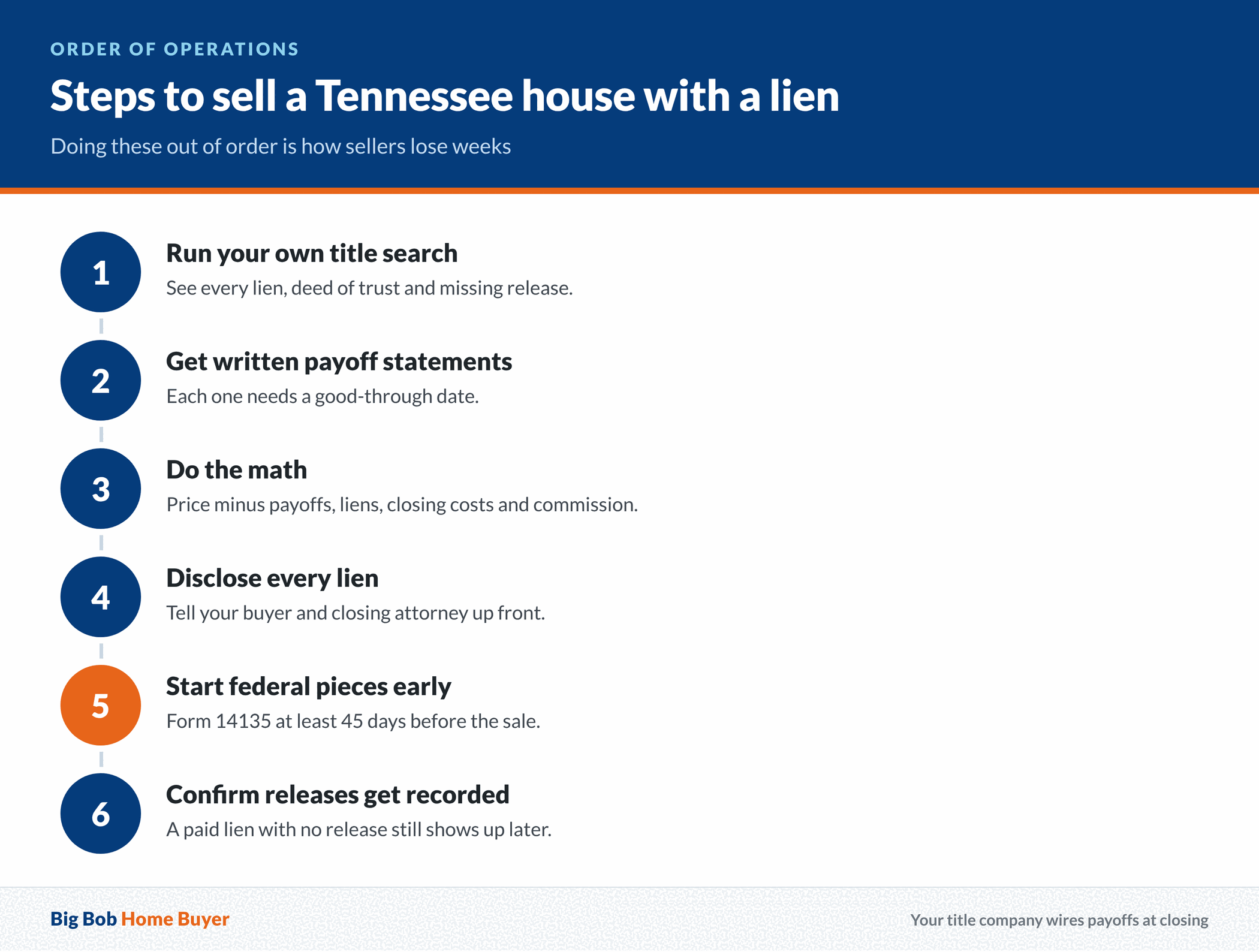
Order matters here, because doing these steps in the wrong sequence is how people lose weeks.
First, run your own title search. A title company or real estate attorney in Tennessee can do one in a few days. You’ll see every lien, every deed of trust, and every release that should’ve been recorded but never was.
Next, get a written payoff statement from each lienholder. Verbal numbers mean nothing at a Tennessee closing. Each payoff letter needs a good-through date, since interest keeps adding up.
Third, run the numbers. Add up the first mortgage payoff, every lien balance, closing costs, and any commission. Then subtract that total from a realistic sale price for your Tennessee neighborhood.
Fourth, disclose. Tell your buyer and your closing attorney about every lien you know of, right at the start.
Fifth, get any federal pieces moving early. Form 14135 should be filed at least 45 days before the sale or settlement meeting, so a federal tax lien on a Tennessee property needs attention the day you decide to sell.
Last, make sure the releases actually get recorded. A paid lien nobody released still sits in the Tennessee land records and will haunt the next transaction.
Knoxville sellers have a little more breathing room than Nashville right now. Over the three months ending October 2026, Knoxville homes sold at a median of $325K, up 4.8% year over year, and spent 49 days on the market on average.
What If You Have Multiple Liens or a Disputed Lien?
Stacked liens get messy fast. Two of them rarely cost just twice as much to clear as one, because each holder negotiates separately.
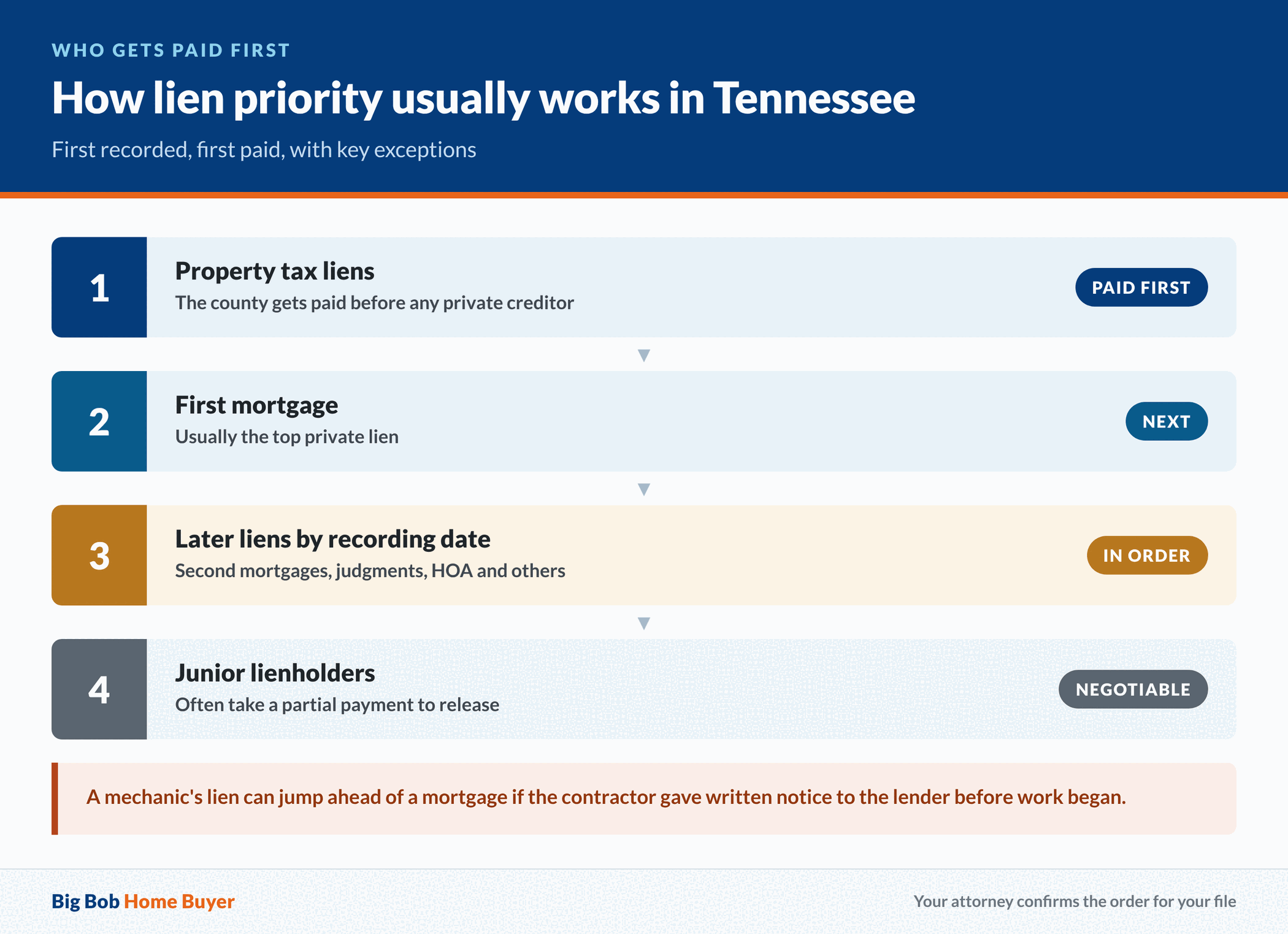
Priority in Tennessee mostly follows the recording date: first recorded, first paid. Your first mortgage usually sits at the top. Property tax liens in Tennessee outrank almost everything, mortgage included, because the county gets paid ahead of any private creditor.
With stacked liens, you negotiate rather than just run the math. When proceeds won’t cover everybody, junior lienholders know a foreclosure leaves them nothing, so they’ll often take a partial payment to release. A creditor in fifth position has almost no leverage at all.
Under certain conditions, mechanic’s liens can cut the line. A Tennessee mechanics lien can take priority over an existing mortgage if the contractor gave the mortgagee written notice before work began. It’s rare, but it happens.
Disputed liens call for a whole different approach. A contractor who recorded late, a judgment paid off years ago but never released, a lien naming the wrong parcel: your attorney can fix every one of those. Sometimes nothing more than a demand letter is needed.
Who should you call first when a lien looks wrong? A Tennessee real estate attorney, not your agent and not the creditor. Calling the lienholder yourself can stir up conversations you’d rather leave asleep.
What Mistakes Do Sellers Make with a Lien?
“If I don’t bring it up, maybe nobody will notice.” Somebody will. Title companies in Tennessee exist to find exactly that lien, and a seller who hides one loses trust right when they need the buyer’s goodwill most.
Waiting is the costlier mistake. A lien balance keeps growing while you think it over, with interest added month after month on most judgment and tax debts in Tennessee.
Sellers overestimate equity constantly. They anchor to Zillow and forget that the payoff, the lien, and the closing costs all come out of the same pot. Nashville’s median sale price over the three months ending October 2026 was $457K, down 3.8% from the year before, with homes averaging 66 days on the market. A softening price in your zip code eats into the cushion you were counting on.
I run into another one a lot. Sellers pay a lien directly, shake hands, and never check that the release made it into the county records.
Hiring the wrong help costs money too. A general practice law firm can handle a lien release, though a Tennessee closing attorney who works title every day will move faster and charge less.
A man called one Wednesday afternoon from Bartlett, out near Memphis. He was splitting assets in a divorce and just wanted the sale over with. The place carried a judgment lien plus a second mortgage he’d forgotten about, and a garage full of woodworking tools neither spouse wanted to haul. I’ve seen that forgotten-mortgage story more than once. We cleared both liens through closing, and he never had to meet the buyer.
Frequently Asked Questions
How Long Does a Contractor Have to File a Lien in Tennessee?
Tennessee gives contractors and suppliers a fixed window that starts when their work wrapped up or the project was abandoned, and it gets shorter if the owner records a notice of completion. Subcontractors also have their own notice duties before they can record at all. Your county register of deeds can show you what’s filed against your parcel, and a Tennessee construction attorney can tell you whether a particular lien was recorded on time.
Can I Sell If I Owe More Than the House Is Worth?
Possibly, though you’ll need your creditors to cooperate. When the mortgage plus other claims come to more than the sale price, closing only works if those creditors agree to accept less than they’re owed. Junior creditors often go along, since a foreclosure would leave them with nothing. Talk with a Tennessee real estate attorney before you sign a contract so the payoffs are settled first.
Can You Sell a House with an IRS Lien on It?
You can, and it happens regularly in Tennessee. The IRS has a formal process for releasing a single property from a federal tax lien so a closing can go through, and it grants those requests when the numbers make sense. Start the paperwork as soon as you have a signed contract, since the review takes real time and your buyer’s lender won’t wait forever.
Who Cannot File a Mechanic’s Lien in Tennessee?
Not everyone who sets foot on a job site has lien rights in Tennessee. Companies that lease equipment to a project don’t hold mechanic’s lien rights under Tennessee law, and public works projects are off limits too; those claimants go after a payment bond instead. Anyone who missed the statutory notice or recording deadlines also loses lien rights, even when the debt itself is perfectly valid.
Does a Lien Stop Me From Transferring the Deed in Tennessee?
No. You can sign a deed and transfer ownership of Tennessee property while a lien is still recorded against it. What you can’t do is hand the buyer clear title, so any buyer using a mortgage will need the lien satisfied at closing. Cash buyers sometimes take property subject to a lien, though they’ll price that risk in.
Got a house with a lien and no idea what it’s worth once everything gets paid? We’re glad to run the numbers with you and tell you honestly whether selling makes sense now. Call or reach out through the site whenever you’re ready. There’s no pressure, no obligation, and no hard feelings if you decide to handle it another way.
Selling a House With a Lien in Memphis
Equity is tighter in Memphis than in most of Tennessee, which makes every payoff matter more. Zillow listed a $151,037 median sale price for Memphis in September 2026. After a mortgage and a judgment or two, that number can shrink fast.
We’re investor home buyers in Tennessee who handle payoffs and releases through closing, so you don’t have to clear every claim before you sell.
Talk to Us About Your Lien
Not sure how much that debt will take out of your sale? Get in touch with us or fill out the form below, and we’ll go over your payoff math with you, no pressure.